
Seat Leon Rear Springs: Specs, Fitment & Common Faults
Confirmed directly in VW Group's own workshop documentation: the rear spring is a separate, distinct assembly from the shock absorber, even on the simpler torsion beam axle.
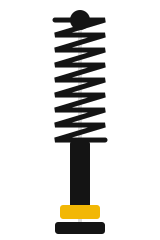 Illustration for editorial purposes
Opens live listings in a new tab.
A Separate Part From the Shock Absorber — Confirmed by VW Group's Own Documentation
Genuinely worth knowing on the Seat Leon: VW Group's own workshop manuals list the rear spring as a distinct removal and installation step from the shock absorber, with its own upper and lower spring seats — even on the simpler torsion beam rear axle. This means a spring can fail (sag, crack, or corrode through) independently of the shock absorber, and vice versa, so it's worth diagnosing which has actually failed before assuming both need replacing together.
Seat Leon Rear Springs: A Part That Fails Quietly, Then Suddenly
A sagging Seat Leon rear spring rarely gives dramatic warning — just a slightly reduced ride height over several months — before eventually failing suddenly at the coil's end with an audible clunk. Keep an eye out for one rear corner sitting lower than the other as an early tell.
Seat Leon Rear Springs: OEM Part Number
| Torsion beam axle, standard rate | Confirm the colour-code marking on your existing spring before ordering — VW Group uses this to distinguish rate variants within the same axle type |
|---|---|
| Multi-link axle (higher-output/4Motion variants) | A genuinely different spring and spring seat design from the torsion beam version, reflecting the different axle architecture |
| Estate/higher-load body style, where applicable | Genuinely a stiffer rear spring rate than the equivalent standard body style, to handle the increased load-carrying capacity |
A single new rear spring on the Seat Leon, next to an old, sagged one, creates an imbalance — uneven ride height and a handling bias — which is why replacing them as a pair is the better approach.
Seat Leon Rear Springs: What It Does
The Seat Leon's rear coil spring supports the weight of the car's rear end and absorbs the initial impact of a bump, working alongside the shock absorber (which controls the spring's rate of compression and rebound) rather than replacing its function. A sagged or broken spring lowers ride height, can affect headlight aim, and in severe cases is an MOT failure item.
Opens live listings in a new tab.
Seat Leon Rear Springs: Warning Signs, DIY Difficulty & Aftermarket Advice
These are the same regardless of make or model — see our full Rear Springs Guide for symptoms of a failing spring, confirming fitment against your VIN, and OEM vs aftermarket guidance.
More Seat Rear Springs
The same part, covered across other Seat models.