
Subaru Forester Exhaust System: Specs, Fitment & Common Faults
A genuinely alarming, honest account: a catalytic converter replaced four times under warranty on the same car, with the same code returning each time, because the root cause was never actually diagnosed — just the symptom repeatedly swapped.
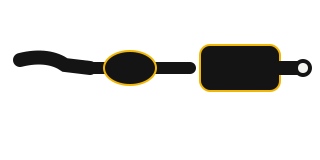 Illustration for editorial purposes
Opens live listings in a new tab.
Subaru Forester Exhaust System: OEM Part Number
| Left-bank exhaust manifold with catalytic converter | Subaru's horizontally-opposed "boxer" engine genuinely has two separate cylinder banks, each with its own manifold and catalytic converter — this is a distinctly different physical layout from an inline engine's single manifold, and the left and right units are not interchangeable |
|---|---|
| Right-bank exhaust manifold with catalytic converter | A genuinely separate part from the left-bank unit above — both banks feed into the shared downstream system, but each has its own dedicated cat |
| Centre/intermediate pipe | The section where both cylinder banks' exhaust streams merge into a single pipe, genuinely separate from the twin front manifolds and the rear silencer |
| Rear silencer | Confirm your exact engine and trim, since Subaru used multiple distinct rear silencer references across most model generations — Symmetrical All-Wheel Drive is standard across nearly the whole range, so there's no separate FWD-specific silencer to worry about on most models |
Subaru Forester Exhaust System: The Part That Announces Its Own Problems
On the Subaru Forester, most faults are things you'd spot visually first, but this one usually announces itself acoustically — a rattle, a drone, a noticeable jump in noise levels. That's actually helpful, since it means you'll likely notice trouble well before it gets serious.
Subaru Forester Exhaust System: What It Does
Three jobs happen inside the Subaru Forester's exhaust system: routing burnt gases away from the engine, quieting them through the silencer, and treating emissions via a catalytic converter and particulate filter. Petrol and diesel variants often need completely different systems to meet their respective emissions requirements.
Opens live listings in a new tab.
A Genuinely Alarming, Honest Real Account Worth Knowing — Subaru Forester Exhaust System
If you're facing a recurring P0420 code and catalytic converter replacement, this is genuinely worth knowing before agreeing to another straight swap: one documented case on a 2017 Forester saw the catalytic converter replaced under warranty four separate times, roughly every four months, with the exact same code returning each time — because the underlying root cause was never actually diagnosed, only the symptom repeatedly swapped out. It's genuinely worth knowing that replacing a catalytic converter without first identifying and fixing whatever actually damaged it — commonly a poor battery or earth connection, a vacuum leak, a separate exhaust leak, or a faulty sensor giving the engine incorrect feedback — will very likely just result in the replacement failing again in exactly the same way.
It's also genuinely worth knowing that P0420 doesn't automatically mean the catalytic converter itself has failed — the code specifically relates to catalyst efficiency falling below an expected threshold, which can be triggered by several of the causes above without the converter itself being physically damaged at all.
Subaru Forester Exhaust System: Warning Signs, DIY Difficulty & Aftermarket Advice
These are the same regardless of make or model — see our full Exhaust System Guide for warning signs and fault codes to watch for, confirming fitment against your VIN, and which aftermarket brands are worth trusting.
More Subaru Exhaust System
The same part, covered across other Subaru models.